In Las Vegas, NV, AC repair starts with a diagnosis that you can follow, covering what failed, how that was confirmed and what the repair options are. Most calls in hot weather come down to capacitors, contactors, blower motors, condensate drains, refrigerant leaks or thermostat faults. Use Call Now, describe what the system is doing, and an independent HVAC contractor serving 77 ZIP codes around Las Vegas will answer.
Parts that fail most often
| Part | What it does | How it fails |
|---|---|---|
| Thermostat | Tells the system when to run | Fails, loses batteries or is miswired |
| Blower motor | Moves air across the coil and through ducts | Bearings wear, the capacitor fails or the motor overheats |
| Contactor | Switches power to the outdoor unit | Contacts pit and stick, or the coil fails |
| Run and start capacitors | Store charge to start and run motors | Weaken with heat, causing humming or no start |
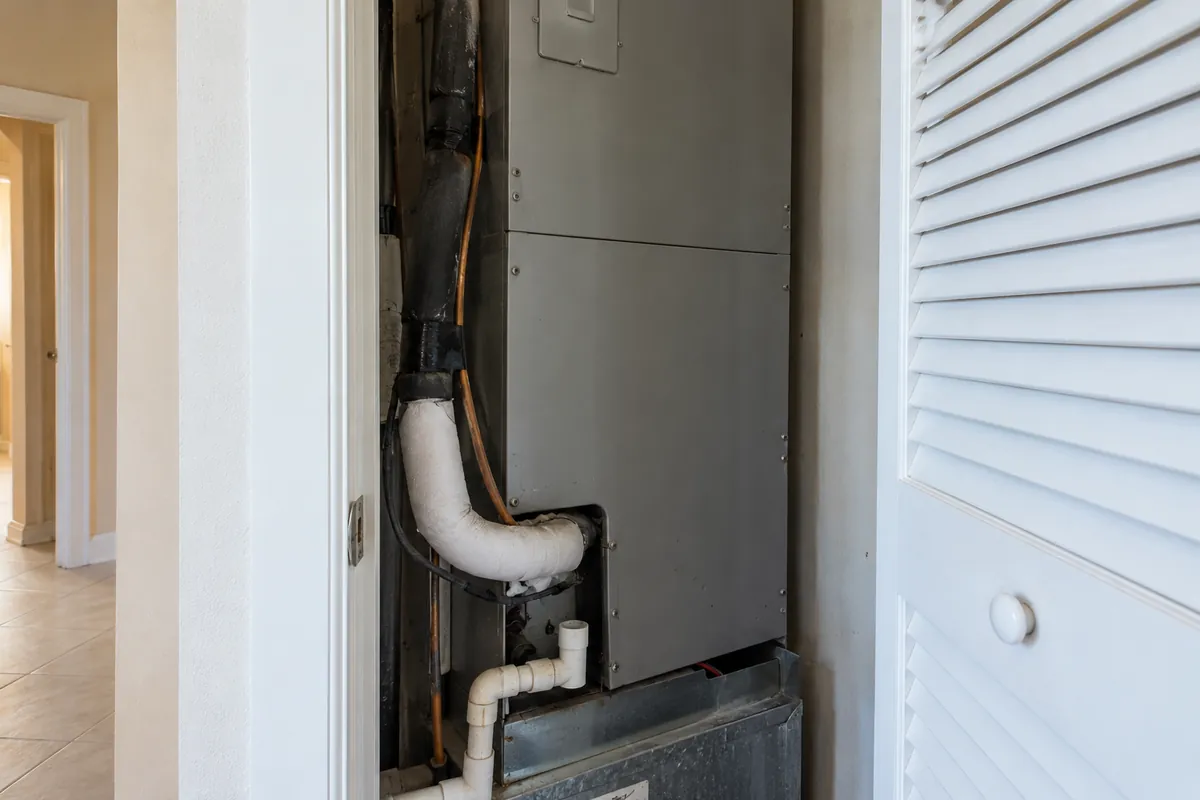
| Condensate drain and float switch | Carries away moisture and shuts the system down if blocked | Algae clogs the line and water backs up |
| Refrigerant lines and coil | Carry refrigerant between indoor and outdoor units | Develop pinhole leaks from vibration or corrosion |
Condensate drain: the leak that stops the system
On a humid day an air conditioner pulls several gallons of water out of the air, and the drain line carries it away. When algae and debris clog the line, the pan overflows and the float switch turns the system off to prevent a ceiling leak. Repeat problems are reduced by clearing and flushing the line and by adding a cleanout and a second float switch.
Airflow problems inside the house
- A dirty or too-restrictive filter
- Closed or blocked supply and return registers
- Crushed, disconnected or leaking ductwork in the attic
- An undersized return that causes high static pressure
- A blower motor or wheel that is dirty or failing
Repair, repair-and-monitor or replace
Replacing a part is usually the right fix if the rest of the system is sound. When an older system needs a major repair, for example to the compressor or a coil, it is worth comparing with replacement, particularly if the unit runs on R-22 refrigerant or has leaked before.
Find out from the technician the system's age and refrigerant, the warranty on the new part and where the rest of the system stands on warranty.
Questions to ask before approving a repair
- How old is the system and which refrigerant does it use?
- Will you give me the findings and the scope in writing before work starts?
- What does the repair warranty cover and for how long?
- What are my options: repair now, repair and monitor, or replace?
- What failed, how did you confirm it and can you show me the part or the reading?
How an AC repair visit works, step by step
A diagnostic visit should follow a repeatable order so the technician finds the cause, not just the symptom. Knowing the order helps you tell a thorough visit from a part swap.
- Interview: what you noticed, when it started, how the system sounds and what you have already tried.
- Visual check: thermostat settings, filter, supply and return registers, the air handler, the condensate line and the outdoor unit.
- Electrical tests: breaker and disconnect, capacitor microfarad rating, contactor contacts, motor amperage and control voltage.
- Airflow and temperature: the temperature drop across the evaporator coil and, where needed, static pressure in the ductwork.
- Refrigerant checks: pressures, superheat and subcooling, and a leak search if the charge is low.
- A written finding: the cause, the repair options and what each one would fix, before any part is replaced.
Mistakes that make AC problems worse
- Putting off a small repair. A weak capacitor can take out a compressor if left alone.
- Adding refrigerant without finding the leak. The charge will drop again and the leak may grow.
- Ignoring a dirty filter. It is the most common cause of poor airflow and frozen coils.
- Setting the thermostat much lower to cool faster. An AC cools at a steady rate, so it only runs longer.
- Running a frozen system. Ice means airflow or refrigerant is wrong, and running it can damage the compressor.
Prepare your Las Vegas home before the technician arrives
- Check that the outdoor disconnect and the breaker are on, but do not open electrical panels
- Replace or check the filter, and clear furniture from the return grille and the air handler
- Set the thermostat to cool and note what it shows and what the house temperature is
- Write down the sounds, smells, leaks or ice you have noticed, and when
- Clear weeds, leaves and debris from around the outdoor unit
What makes AC repair different in Las Vegas
Extreme desert heat with summer highs above 105 degrees and long cooling seasons; attics are far hotter than the air outside. Monsoon moisture in July to September adds humidity spikes.
Nevada contractors are licensed by the Nevada State Contractors Board; refrigeration and air conditioning is the C-21 classification. Dust and sun exposure clog and age condenser coils; many systems last about 10 to 15 years in extreme heat. Ask the technician how these local conditions affect the diagnosis and the equipment recommendation at your address.
AC repair across Las Vegas and nearby cities
In Las Vegas, Nevada, Air Conditioning Installation Las Vegas serves 77 ZIP codes: 89101, 89102, 89103, 89104, 89105, 89106, 89107, 89108, 89109, 89110. Providers working in North Las Vegas, Henderson and Boulder City also receive calls and requests. Because each address is checked on its own, give your ZIP code when you call.
An independent HVAC contractor is one call away: use Call Now at the top of any page and describe the symptoms and the age of the system. The contractor confirms your address, then examines the system in person to diagnose it.
Related help in Las Vegas
If this is not quite your situation, these pages cover the neighboring questions: How to Lower Cooling Bills; What Size AC Do You Need? Tonnage and Load Calculation; AC Repair or Replace? A Decision Guide for Las Vegas; AC Not Cooling? 12 Causes and Fixes. The service area list shows every nearby city and ZIP code covered.
AC Repair in Las Vegas: common questions
What does an AC repair visit include?
A diagnosis of why the system is not working, an explanation of the cause and a written repair option. The provider should show you the failed part or the test reading and confirm any assessment charge before the visit.
Why does my AC keep tripping the breaker?
A failing capacitor or compressor, a shorted wire, or a dirty condenser coil that makes the system run hot are the usual causes. If a breaker trips again and again, a professional should check it.
Can a repair be warranted?
Parts and labor are covered by many providers for a set period, and the terms should be requested in writing.
Do I need to be home during the repair?
A person has to let the technician in so the indoor unit and thermostat can be reached, although outdoor work may not need that.
Why does my AC freeze?
Restricted airflow or a low charge of refrigerant normally causes ice, so turn the cooling off and ask for a diagnosis.
Is it worth repairing an old AC?
That depends on how old the system is, which refrigerant it uses, what repair is required and how parts are covered under warranty. Both options can be laid out by the technician so you can compare.